
Market Research
| Source | Market Scope | Estimated Dollars 2024 |
| LinkedIn Pulse | Electrical Light Switches Market Revenue | $10.5 billion USD |
| Cognitive Market Research | Light Switches and Electrical Sockets Market | $17.55 billion USD |
| Research Nester | Electrical Switch Market | $15.61 billion USD |
| BCC Research | Global Market for Electrical Switches | $15.3 billion USD |
| The Business Research Company | Electric Switch Market (Traditional and Smart) | $14.38 billion USD |
| Polaris Market Research | Light Switches and Electrical Sockets Market | $27.42 billion USD |
Electrical switches market estimates for 2024
Several key trends influenced the electrical switch market in 2024, driving overall demand and impacting sales figures:
- Residential and commercial construction:New construction, along with renovations and remodeling, was a primary market driver.
- Adoption of smart technology:Integration with the Internet of Things (IoT) and other smart home devices contributed to increased sales of advanced, high-value smart switches.
- Energy efficiency:Growing demand for programmable and dimmable switches for improved energy management boosted sales, with one report indicating that 20% of residential switch sales included these features.
- Major industry consolidation:Mergers and acquisitions among distributors, such as the one between IMARK and Affiliate Distributors, created a larger, more powerful market force in 2024.
- Key manufacturers’ performance:Major players in the electrical market, such as Schneider Electric and Legrand, reported strong 2024 financial results partly driven by high demand for data center infrastructure and building electrification.
Market Research
Housing starts forecasted for 2025 show a range of predictions, with some organizations expecting a slight rebound or stabilization around 1.35–1.4 million units, while others, like the Congressional Budget Office, forecast stronger growth to 1.68 million units annually over the next few years before a potential decline. Key factors influencing these predictions include the expected easing of mortgage rates, increased demand from demographics, and a shortage of housing inventory, although the rate of increase in new supply is expected to be slower than in previous years.
New home construction in 2025 is not uniformly trending up, with forecasts and data showing conflicting signals. While some sources predict a significant increase in new homes being built and a rise in sales, others highlight a continued slowdown, citing factors like the “lock-in” effect of high interest rates on existing homeowners, weak demand in some regions, and an increase in unsold inventory. However, there’s a strong emphasis on incorporating sustainable and innovative building trends into future homes, regardless of the overall volume of construction.
The home building industry is evolving faster than ever. Rising material costs, persistent labor shortages, and the growing demand for smarter, more sustainable homes are transforming how builders approach projects. In 2025, veteran builders must embrace cutting-edge innovations—integrating smart home automation, modular construction, and data-driven project management to stay competitive.
This creates an ideal situation for the Quick-E-Box, a plug and play light switch system designed for safe electrical DIY installation and modern home electrical innovation. With the rise of smart electrical devices for homes and the demand for faster, more efficient construction methods, the Quick-E-Box stands out as a revolutionary electrical switch invention. It not only supports DIY electrical repair solutions but also represents a strong business investment opportunity for those seeking to invest in new electrical inventions and innovative electrical product patents.
As the market shifts toward innovative electrical patents and home electrical upgrades, investors in electrical technology can benefit from this US patented electrical invention, built to redefine electrical construction modern solutions for both residential and commercial applications.
Home Improvement Industry
With interest rates high, many people are looking to remodel instead of purchasing a new home. The Quick-E-Box is primarily designed for new construction, but with a little innovation it can be used to replace an existing light switch or receptacle. This represents a significant Quick-E-Box investment opportunity within the growing home improvement sector.
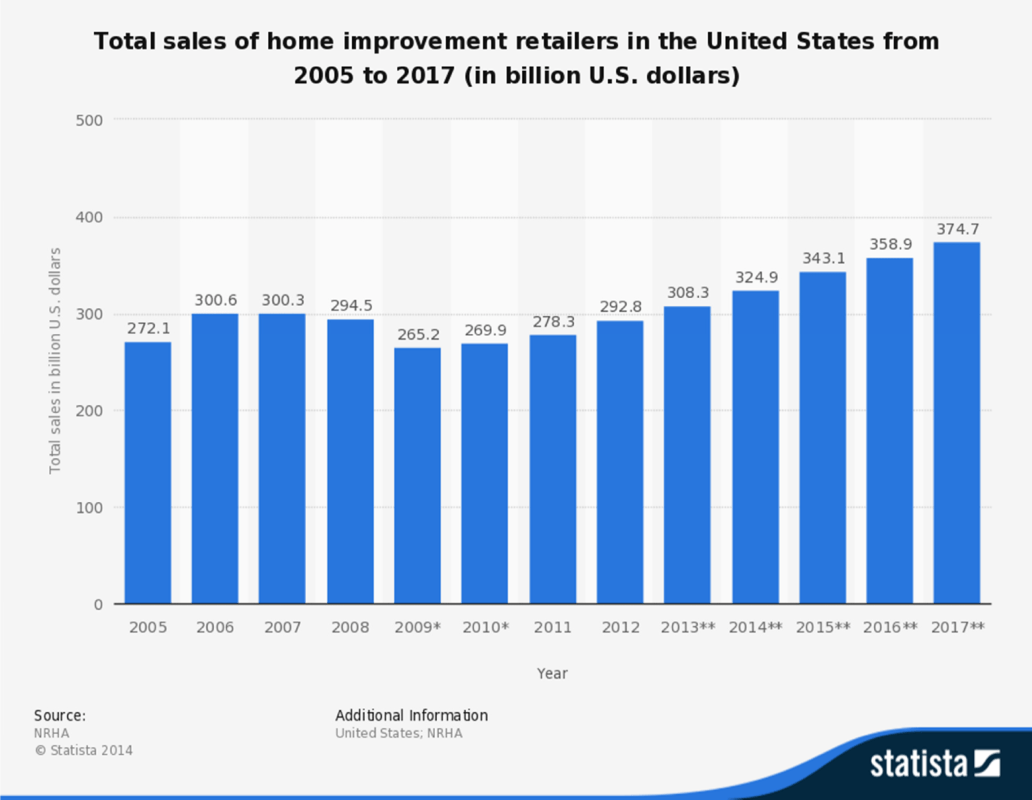
The home improvement retail market is large and diverse, giving customers many options to choose from. These options include concentrated home improvement center box stores or the highly fragmented hardware stores. The customer base ranges from professional contractors to homeowners/renters who are either Do-It-Yourselfer (DIY) enthusiasts or Do-It-For-Me clients. Economies of scale are not necessary in this industry; however, the ability to demand lower prices from product suppliers allows firms to compete on price. Brand loyalty can be found with industry giants like Lowe’s, Home Depot, and Menard’s, but local established stores maintain strong customer bases as well.
In the U.S., the total sales for residential electrical light switches and receptacles were estimated at $5.54 billion in 2024, up from approximately $5.38 billion in 2023. The market has seen a moderate upward trend, driven by home renovation activity and the adoption of smart home technology. This growth also increases investment opportunities in innovative electrical products like Quick-E-Box, supporting the expansion of smart electrical devices for homes.
United States Light Switches and Electrical Sockets Market Size and Outlook 2033
According to Verified Market Reports, the United States Light Switches and Electrical Sockets Market is valued at $2.8 Billion in 2025 and is projected to reach $3.7 Billion by 2033. The market’s growth is driven by ongoing residential and commercial construction, smart home integration trends, and modernization efforts in electrical infrastructure across the country. This ongoing expansion opens new doors for electrical innovation investor opportunities and investment in electrical product patents that enhance residential and commercial systems.
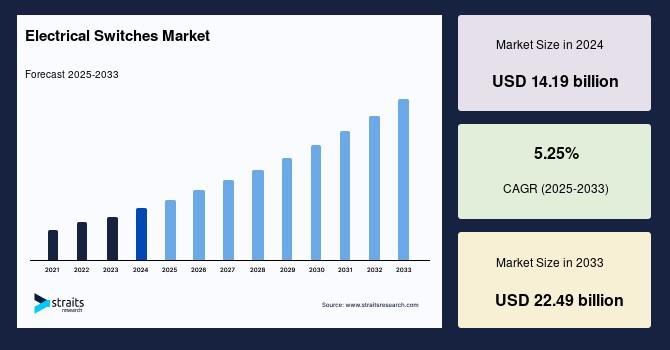
Electrical Switches Market Size
The global electrical switches market was valued at USD 14.19 billion in 2024. It is estimated to reach from USD 14.93 billion in 2025 to USD 22.49 billion by 2033, growing at a CAGR of 5.25% during the forecast period (2025–2033).
Electrical switches are devices that regulate the movement of electric current inside a circuit. They enable users to turn electrical devices on or off, thereby controlling the flow of power to appliances, lights, or other electrical equipment. Switches come in numerous types, including toggle switches, push-button switches, rocker switches, and dimmer switches, each designed for specific functions and applications.
When a switch turns on, it establishes a closed circuit, enabling the passage of electric current to power the connected device. Conversely, when switched off, it interrupts the flow of electricity, effectively cutting off power. Electrical switches play a fundamental role in home and industrial settings, facilitating convenience, safety, and efficient energy use.
In recent years, with the exponential population growth, there has been a rapid surge in urbanization and infrastructure projects being undertaken worldwide, subsequently driving the global market. With ongoing digitization, the rapid proliferation of the Internet, and rising demand for convenience, there has also been a rise in the adoption of smart home devices. This is expected to increase the demand for smart switches, thereby creating opportunities for global market expansion and business investment opportunities in innovative electrical patents and electrical switch technology for investment.
It is impossible to calculate the total number of DIY US home light switch and receptacle replacements, as no entity tracks this specific activity. The DIY electrical market is driven by individual projects within approximately 132.9 million US households, rather than a quantifiable, standardized number of replacements.
DIY electrical replacement statistics are not tracked for several reasons:
- Unreported activity:DIY projects are, by definition, informal and are not tracked in official databases or market reports. Market research data is generally based on market size (the money spent) or surveys of home improvement activity, but does not provide exact numbers of fixtures replaced.
- Widespread but irregular projects:Many homeowners replace a few switches or receptacles as needed for cosmetic updates or repairs. This occurs sporadically, without any central reporting.
- Overlapping market data:Research often reports on the broader electrical services and home improvement markets, which include both DIY and professional jobs, making it impossible to isolate the DIY share for this specific task. For example, the total U.S. residential remodeling market was estimated at $527.36 billion in 2023.
The home improvement retail industry includes over 23,000 home centers and hardware stores, with combined annual revenue of approximately $150 billion. Major players in the home center segment—Home Depot, Lowe’s, and Menard’s—are highly concentrated, with four of the top companies accounting for 90 percent of segment revenue. The hardware store segment is more fragmented, with the top 50 companies accounting for only 30 percent of segment revenue. Competition is driven by low-cost purchasing, effective merchandising, and competitive pricing. Smaller players, primarily hardware stores, compete through specialty products, superior customer service, and local market relationships.
The life cycle of the home improvement retail industry varies across segments. Many hardware/lumber store companies have operated since the late 1800s and remain family-owned. However, this segment has declined due to the rapid growth of large box store companies. The large box store and specialty product segments are in a mature life cycle but still present investment opportunities in innovative electrical products such as Quick-E-Box patented solutions. Companies in the industry must adapt to the growing Do-It-Yourself and Do-It-For-Me customer base, offering low prices, superior service, enhanced customer experience, choice, and quality products, and ease of installation.
However, in this industry, customers are driven more by competitive pricing and quality customer service than brand loyalty. Capital requirements to enter the industry are somewhat high at both national and local levels. Although profit margins are attractive, industry growth rates have been somewhat flat due to a slow economic recovery. This makes investing in electrical product patents such as the Quick-E-Box an attractive investment opportunity for those seeking innovative electrical product patents, electrical innovation investor opportunities, and business investment opportunities in the home improvement market.